
What Is Boning In Sewing?
Even if you've never used boning in your sewing, you're probably familiar with how it looks—ever notice the rigid vertical supports in a corset or wedding gown bodice? That's boning! In this post, we'll take a closer look at this supportive sewing notion, its types, how to use boning in sewing and more. Find the perfect structural solution for your next project with our wide selection of sewing boning & corset busks at WAWAK.

WHAT IS BONING IN SEWING?
So what is boning in a dress, corset, bra or other garment? In sewing, boning refers to flat, stiff strips or rods inserted into a garment to add vertical structure. Commonly used for corsets and bodices, boning acts as the garment's "frame," providing its structure and form. Boning in one form or another has been used for hundreds of years, with the term likely originating from the use of whale baleen (whalebone) in early corsetry. Today, boning is usually made of metal or plastic and comes in various styles and levels of flexibility for different applications.
What Is Boning Used For?
Boning is probably best known for its use in corsetry, where the "bones" create the corset's shape, provide support and maintain a smooth, flat fabric appearance. However, the same idea applies to many garments; boning is commonly used to add support to strapless tops, bras, gowns, bathing suits and more. In bra making, boning is often added to side seams for additional support, especially for strapless bras. It can also be used to shape sculptural or structured garment details such as square necklines, basque waists, skirt yokes, decorative draping and more. Outside of garment making, boning can also be used to add structure to other sewing projects, like stuffed toys and even bags.
Types Of Boning For Sewing, Dressmaking & More
Boning is available in various styles, offering different levels of strength, flexibility and rigidity for different project types. Let's go through some of the most popular boning types and when to use each one.
Metal Boning (also known as flat steel boning, spring steel boning or white boning) consists of thin, flat steel rods, typically coated in white nylon or plastic. This style of boning is very strong but flexible, offering rigid support and structure even when bent. If you're looking to create highly structured garments with very firm support and rigid shape (like genuine corsets, shapewear and stays), this is the ideal option. It bends on one axis, so flat steel boning is best used for straight seams.
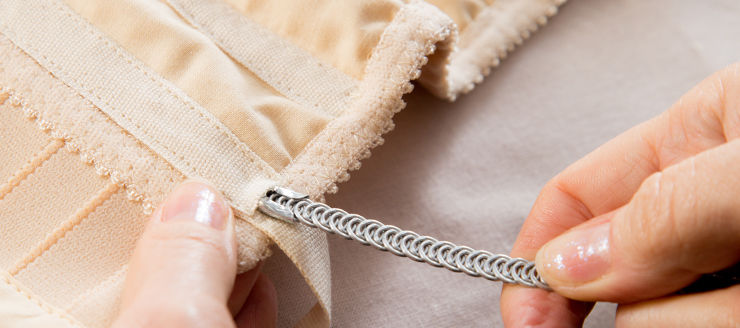
Spiral Steel Boning is also made of metal rods, but the rods are formed into a spiral shape for added flexibility. Unlike flat steel boning, spiral steel boning can bend in multiple directions, making it an excellent option for curved areas like hip curves or waistlines. It's also less rigid than flat steel boning, allowing for a bit more freedom of movement. It’s often used for costumes, dancewear and less rigid stays, corsets and historical attire. In corsetry, flat and spiral steel boning are often used together, with flat boning in straight, smooth areas (like the back and abdomen) and spiral boning in curved or flexible areas, like hip curves and side seams.
Corset busks are unique among the styles of boning because they don't just provide support and structure—they're also fasteners. These secure post-and-loop fasteners are often used in the front of the corset to form a closure that's accessible to the wearer.
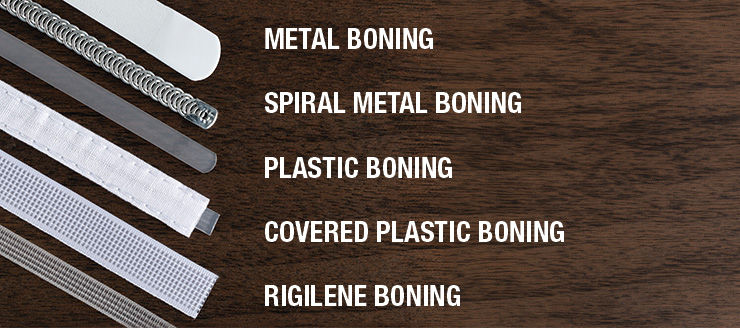
For lightweight, flexible support, plastic boning is an excellent option. Made from flexible, durable plastic, this versatile style of boning is used for a wide variety of projects, including evening wear, costuming, lingerie, swimwear, strapless garments, lightweight fashion corsets and more. Compared to metal boning, plastic is lighter-weight, much more flexible and easier to cut. It's also machine washable, making it a more convenient option for everyday garments. Though not intended for genuine shapewear (like corsets intended to shape the body), plastic boning is a great addition to a wide variety of structured textiles.
Want to skip sewing a casing? Covered boning consists of plastic boning that comes already inside a fabric casing—simply cut to size and stitch the casing to your project to install. This ready-to-use plastic boning is an excellent option for strapless tops, fashion corsets, dresses, swimsuits, stuffed toys and more. If you're looking to add boning to an existing garment, this is an excellent option!
Rigiline is one of the lightest-weight and most flexible boning styles, ideal for adding very light support to everyday garments. Made of a mesh-like plastic, this style of boning is ideal for blouses, swimwear, dresses and more. Best of all, Rigilene is easy to use: it’s the only style of boning that can be sewn through directly.
HOW TO USE BONING IN SEWING
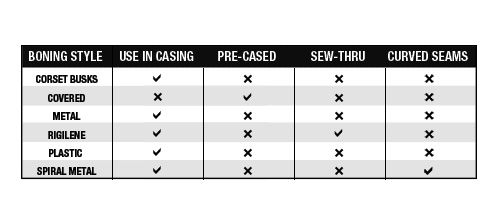
When you're planning a project with boning, there are a few things to keep in mind. Check out the quick tips and chart below for a quick reference on how different types of boning are used.
Installation: Most boning is used inside a channel or casing. If you don’t want to sew a channel or can’t add one to your project, you have two other options: covered boning, which comes pre-cased, or Rigilene, which can be sewn through directly.
Placement: Most boning styles don't curve side-to-side and are best for straight seams. For curved areas, spiral steel boning is your best bet.
Sizing: At WAWAK, boning is available in a wide range of pre-cut sizes. However, if you’d prefer to cut your boning to size yourself, you can use a pair of boning cutters to cut through it and end caps to round off the edges.
Find High-Quality Boning For Sewing at WAWAK
Whether you’re sewing a swimsuit, costume or corset, find everything you need for working with boning at WAWAK. With our wide selection of quality notions and super-fast shipping, we have exactly what you need, when you need it. Happy sewing!


